Friday, July 24, 2026

Solo founder boom part 2: distribution and marketing

This is part 2 of the solo founder boom essay. Part 1 covered why vibe coding can be a useful starting point and why quality remains a separate wall. If you want the beginning first, read solo founder boom part 1.

The focus here is solo founder marketing. Distribution and marketing are not just ad buying; they require a product distribution strategy and a clear view of the startup marketing bottleneck that stops a promising product from reaching enough people.
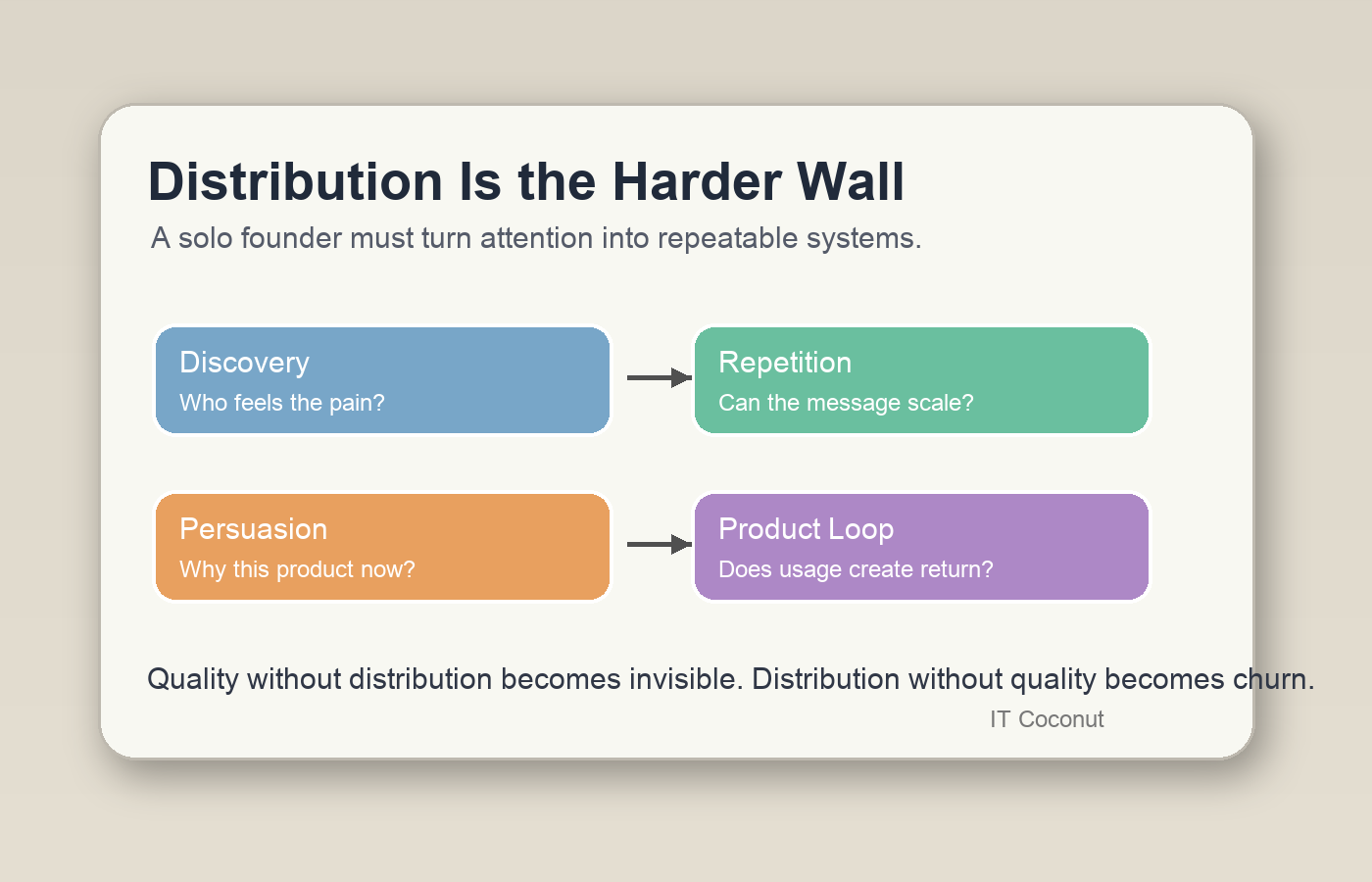
A desk board showing discovery, persuasion, repetition, and product loops as the distribution system for a solo founder

<Distribution and marketing bottleneck board 1.1>

The harder wall is distribution, which means marketing

Even if the product becomes reasonably good, the business is not done. Distribution is the harder wall. A good product and a product that reaches customers are different things. Marketing is hard even for marketing professionals. In most categories, modern markets are red oceans: similar products, similar messages, similar ads, similar landing pages, and similar founder stories all compete for the same few seconds of attention.

The rise of the creator economy makes sense in that environment. Search ads and display ads alone often fail to create trust, so people with YouTube channels, TikTok accounts, newsletters, podcasts, and communities have become new distribution networks. AMT’s creator economy overview describes the creator economy as a market already worth roughly $200 billion in 2024 and increasingly treated by brands as a performance acquisition channel rather than a loose awareness experiment.

But this also creates a dangerous illusion. Social platforms mostly show the outcome. “I built it alone.” “I made revenue in a month.” “I grew without ads.” Those lines sound clean, but they hide accumulation: an existing audience, a practiced content instinct, a deep feel for customer language, repeated failures, luck, timing, and sometimes invisible ad spend.

The most dangerous belief in solo founding is that a good product will automatically spread. Sometimes products do spread by themselves. But that moment usually comes after deliberate product design, repeated experiments, a receptive market, a strong problem, and a long period where almost nobody is watching.

Distribution can be split into three stages.

Distribution stage What the founder must do Why it fails
Discovery Find who actually suffers from the problem The customer definition is too broad
Persuasion Explain why this product matters now The founder explains features but not pain
Repetition Make the same message work across channels Content, ads, and product data are disconnected

This is where IT products matter again. An IT product is not merely something sold online. It measures behavior, creates repeated touchpoints, automates payment, learns from usage data, and builds recommendation and return loops. AI coding on Mac and other AI coding tools can speed up creation, but the product’s data and automation are what make marketing more repeatable. AI developer productivity only becomes business productivity when it also reduces bottlenecks in sales, onboarding, support, and operations.
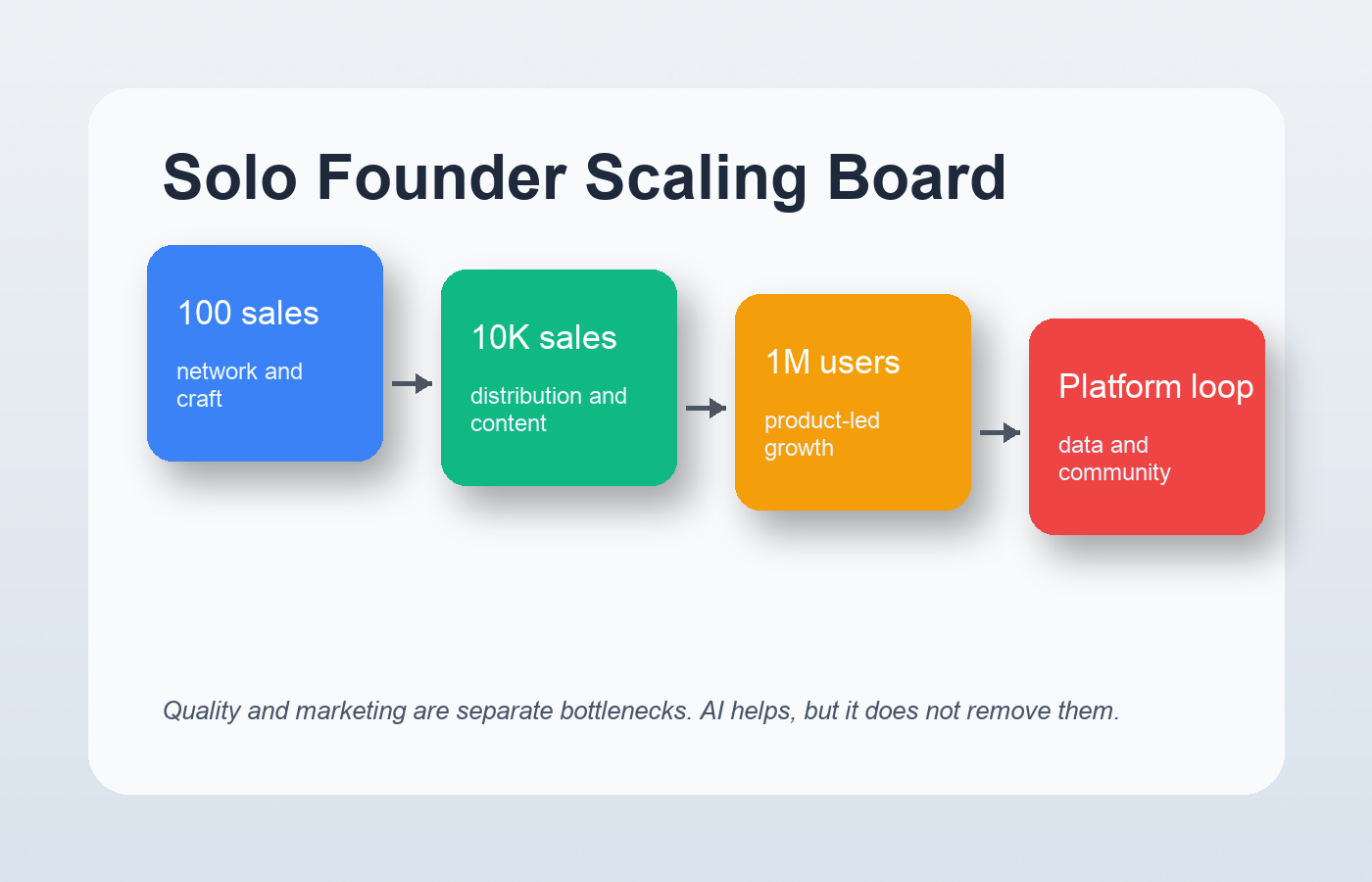
A colorful board showing how a solo founder moves from hand selling to distribution systems and platform loops

<Solo founder scaling board 3.1>

Marketing is a longer and more exhausting fight than most founder content admits. Reaching a customer once is hard. Being remembered later is harder. Large companies spend enormous marketing budgets not because they have nothing better to do, but because a place in the customer’s mind is expensive. Individuals, small teams, organizations, and giant companies all face that same problem. The scale of the budget differs, but the difficulty is shared.

The realistic solo founder formula is leverage, not being alone

None of this means solo founding is hopeless. The opposite is true. This is probably the best time in history for individuals to access leverage. Work that once required a technical team can now be started by one person. Experiments that once needed an agency can be tested directly. A small business can combine Stripe, global SaaS tools, and APIs into an operating system that would have looked impossible a decade ago.

But the formula is not “do everything alone.” It is closer to “start alone, but design leverage.” A solo founder has fewer employees, not fewer business functions. Product planning, development, design, payments, support, content, advertising, analytics, accounting, legal work, and security still exist. The difference is whether those jobs are handled only by the founder’s labor or increasingly by tools and systems.

Success condition Question Practical solo founder behavior
IT products Can the business become a repeatable product? Turn manual service work into templates, dashboards, booking, and payment flows
Quality Can quality hold as customers increase? Fix errors, onboarding, refunds, and support before adding more features
Marketing Is customer acquisition repeatable? Commit to one channel such as content, search, partnerships, or community
Data What guides improvement? Track visits, signups, payments, returns, and reasons for churn
Scaling strategy Are you ready to change rules as scale changes? Learn manually, automate repeated work, then design product loops

I do not think solo founding is impossible. I do think the popular version of the story, “just vibe code an app and launch,” is too thin. An app is the beginning. A business exists when customers pay, keep using it, tell others, and the operator can handle that repetition without burning out.

So the central question in the solo founder boom is not “can one person start?” The better question is “how much of what one person starts can become a system?” As Masters of Scale repeatedly frames growth as a stage-by-stage discipline, the skill needed to sell 100 units is different from the skill needed to serve 1 million users. Founders who accept that difference have a better chance of lasting.

The right attitude toward vibe coding is neither dismissal nor blind belief. Vibe coding is a useful marketing story and a useful production tool. It is especially powerful for early tech startup funding validation, prototypes, and narrow workflow products. But the final force that turns a product into a company still comes from quality and marketing. Those two are hard for individuals, teams, and large companies alike. That is why they matter.

The era of solo founders has arrived. But the winning formula is not “one person does everything.” It is “one person starts, then the product and system do more work than one person ever could.” In the current era, that system usually has an IT product at its center. And if that product is going to survive in the market, durable quality and stubborn distribution matter more than flashy build speed.

Solo founder boom part 1: vibe coding and the quality wall

Solo founder boom: can vibe coding really create economies of scale?

Open YouTube, X, TikTok, or any founder community for long enough and the same story keeps showing up: this is the age of the solo founder. One person can record content, launch a landing page, attach a payment link, and start selling. Add vibe coding to the story, and the pitch becomes even stronger. The phrase vibe coding solo founder now captures the promise that you do not need to write every line of code. You describe what you want, an AI tool builds a working product, and a one person business suddenly looks possible.

I do not think that direction is wrong. In fact, it is probably one of the most important shifts in small business right now. But one question is often missing. Building something alone and turning it into a business with economies of scale are completely different problems. The method that sells 100 units, the method that sells 10,000, and the method that reaches 1 million users are not just larger versions of the same thing. At each stage, the rules change.

The U.S. Census Bureau reported that the United States had 29.8 million nonemployer businesses in 2022, meaning businesses with no paid employees, with $1.7 trillion in receipts. A later Census story said nonemployer establishments kept growing through 2023 and that their average annual growth from 2012 to 2023 outpaced employer businesses. So yes, the era of one person businesses is real. But that does not mean large solo businesses are easy. The data actually suggests the opposite: more people are operating alone, while the number of solo operators that break into large scale remains limited.

The argument of this essay is simple. Solo founding is more possible than before, but big outcomes still depend on IT products, quality and marketing, and the ability to build economies of scale. Vibe coding lowers the cost of getting the first product into the world. It does not remove every bottleneck in the business.

Solo founding became easier, but scale did not

The solo founder boom is persuasive because the tooling really has changed. In the past, one person needed a developer, designer, marketer, support person, payment system, hosting stack, and operations workflow just to get started. Today, many of those layers are available as software. No code builders, payment infrastructure, cloud platforms, generative AI, and automation tools have moved into the hands of individuals.

But a business does not end at “can I build it?” It has to sell. It has to deliver the same thing repeatedly. It has to hold quality when more customers arrive. That is where solo founding gets much harder.

Scale stage What can work Capability required Main bottleneck
100 sales Personal network, communities, hand selling Trust, explanation, fast response The founder’s own time
10,000 sales Content, ads, partnerships, search traffic Distribution, funnels, customer data Marketing efficiency and operations
1 million users Product led growth, network effects, platform loops Product strategy, automation, infrastructure Quality, security, scalability, brand

The point of this table is blunt. The larger the scale, the less a business can rely on the founder’s stamina. Selling 100 pens through friends and personal trust is possible. Selling 10,000 requires distribution, content, advertising, inventory or fulfillment, and customer support. Reaching 1 million users requires a product that carries its own expansion loop. People need to arrive, stay, refer, return, and trust the product without the founder manually pushing every interaction.

That is why modern solo founding almost inevitably needs IT products. By IT products, I do not only mean a venture backed SaaS platform. I also mean booking flows, payment pages, course platforms, automated estimates, customer dashboards, CRM systems, recommendation engines, onboarding emails, community tools, analytics, and anything else that turns repeated work into a system. When Stripe talks about financial infrastructure from the first transaction to the billionth, it is describing this same reality. Modern businesses need payments, subscriptions, billing, data, and automation inside the product if they want to grow beyond the founder’s hands.

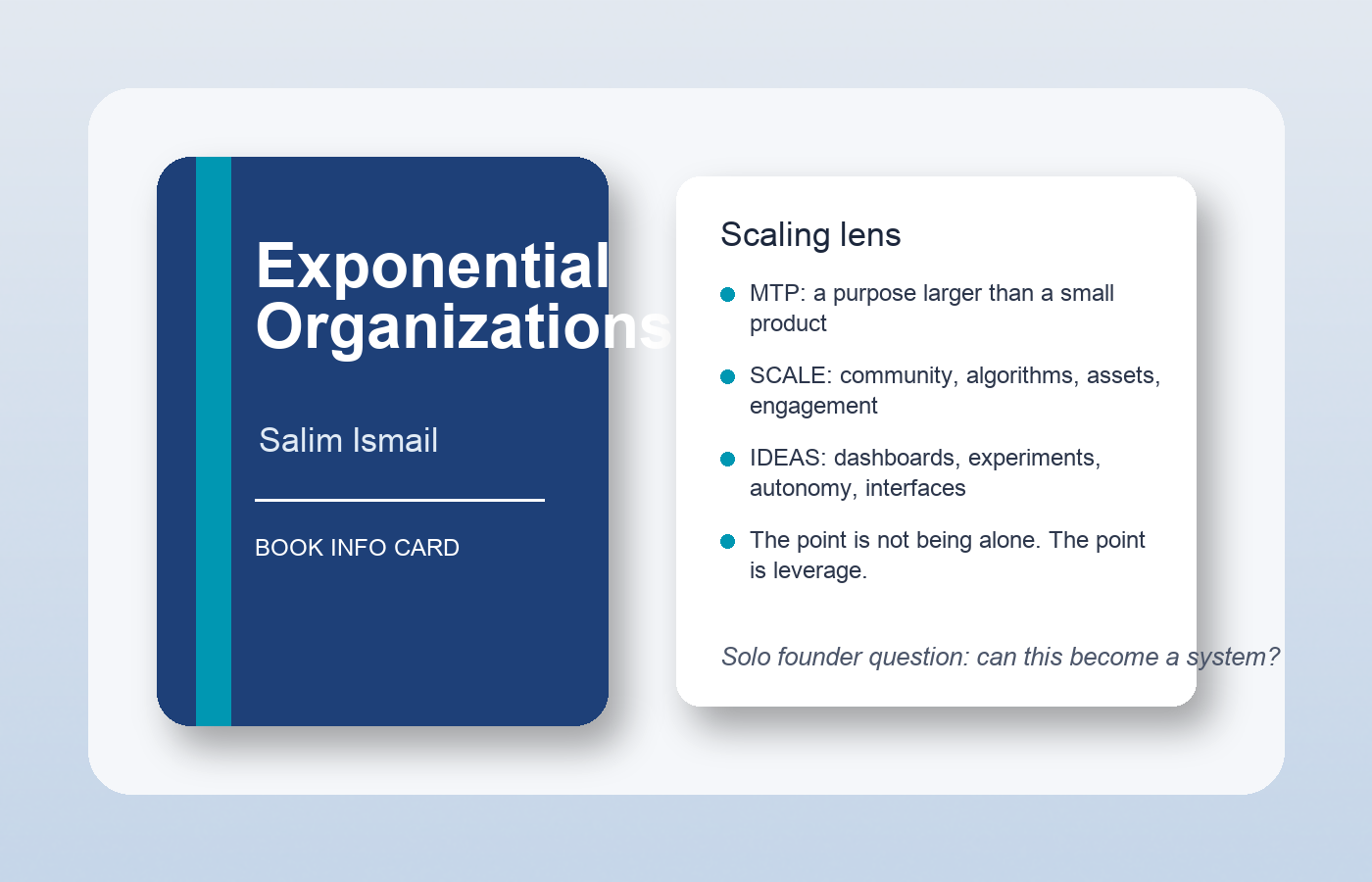
A desk scene showing an Exponential Organizations book information card with scaling notes

<Exponential Organizations book information card 1.1>

Salim Ismail’s Exponential Organizations, published in Korean as 《지수형 인간》, is useful here because it gives language to this exact gap. The book argues that fast growing organizations do not scale only by adding more people. They use information technology, algorithms, communities, external assets, and engagement mechanisms to increase output. Readingraphics’ summary describes the ExO framework through ideas such as MTP, SCALE, and IDEAS. The vocabulary belongs to business books, but the lesson is sharp for solo founders.

If you are working alone, you need leverage even more than a team does. You cannot add staff every time demand rises, so the system has to absorb more of the work. Without that leverage, solo founding is not freedom. It becomes a high pressure self employment job where the founder is the product manager, developer, marketer, salesperson, support desk, and operations team at the same time.

Vibe coding is a strong starting point, but quality is a separate problem

Vibe coding became tied to solo founding for an obvious reason: it lowers the product creation barrier. Business Insider reported on Andrej Karpathy’s February 2025 description of a new style of coding where you “fully give in to the vibes.” In practice, the founder describes a feature in natural language, an AI tool generates code, and the founder keeps testing and steering the result.

This works especially well from zero to one. Landing pages, internal tools, MVPs, simple web apps, and prototypes can be produced much faster than before. Forbes described solo founders using tools such as Replit, Cursor, Lovable, and Claude Code to build digital products and test revenue; that is the same productivity pressure behind AI coding on Mac. Given that shift, it is not surprising that “solo founding equals vibe coding” has become a strong marketing line.

The problem starts after the first version. Human level software quality does not appear just because a lot of code was generated. Good software comes from understanding the customer’s real problem, deciding what not to build, handling edge cases, recovering from failures, checking security, and feeding customer complaints back into product decisions. That work is related to coding, but it is not just coding.

Quality area What vibe coding helps with What the human still owns
First screen and MVP Layout, basic logic, sample data Problem definition and willingness to pay
Feature additions Common implementation patterns Prioritization and scope control
Testing Test scaffolds and repeated checks Deciding which failures matter
Security and scalability Checklists and partial fixes Architecture, permissions, operational responsibility
Customer care Chatbots and email automation Complaint interpretation, refund policy, trust repair

Startups.com’s overview of vibe coding draws a similar boundary. Vibe coding works well for prototyping, greenfield projects, common web app patterns, and automation scripts. It struggles with complex existing codebases, performance critical systems, security sensitive work, complex debugging, and production scale. In other words, vibe coding is a way to get a product into the world faster. It is not an automatic quality guarantee.

This is where the first wall appears: quality and marketing. Quality is not a one time checklist. It is a probabilistic measure built over time. A product working today does not prove that it is good. It has to work for different customers, in different environments, with different mistakes, over many support cycles. It has to become more reliable as complaints repeat. It has to keep basic promises even when the founder is asleep. That takes planning, customer experience, painful iteration, and operations sense.

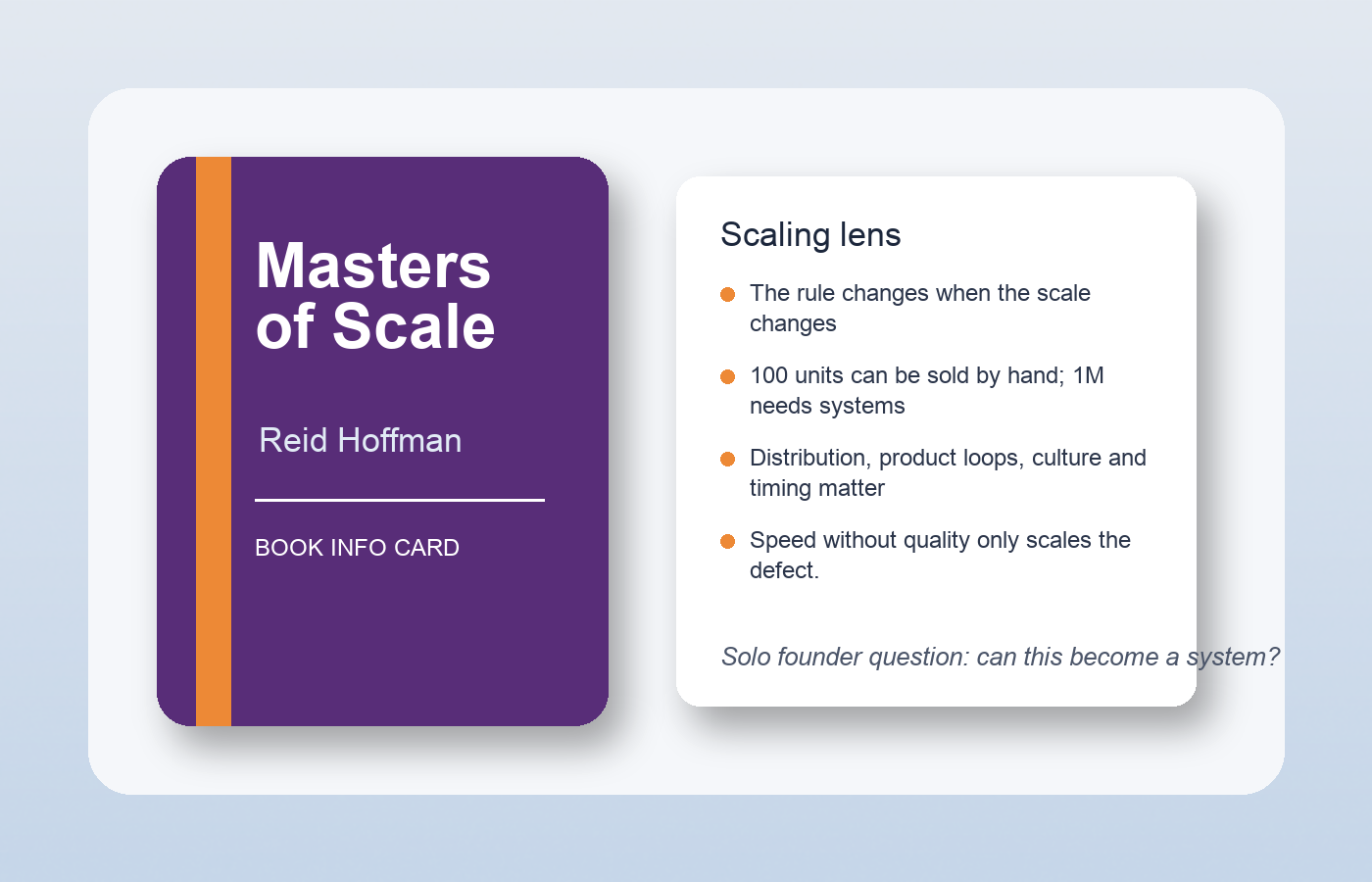
A desk scene showing a Masters of Scale book information card with staged growth notes

<Masters of Scale book information card 2.1>

Reid Hoffman’s Masters of Scale is relevant for exactly this reason. The Masters of Scale profile describes Hoffman as LinkedIn’s cofounder, a Greylock investor, and the host of a show focused on how companies grow. The useful idea is not simply “grow fast.” It is that a company needs different rules at different stages of scale. Manual work that makes sense early becomes a bottleneck later. But automating too early can freeze the product before the founder understands the customer.

So a solo founder using vibe coding has to care about sequence. First, touch the customer’s problem by hand. Then productize the repeated parts. After that, automate the operations that would break as customers increase. Skip that order and a fast built product becomes a fast breaking product.

Thursday, July 23, 2026

Hermes Agent Setup: Connecting GPT, Telegram, and Scheduled Automation

Hermes Agent is an open-source personal AI agent from Nous Research. Instead of living only inside an IDE, it can run on a computer or server and connect language models, terminal commands, files, messaging, scheduled jobs, skills, and logs into one automation environment.

The appeal is easy to understand: send an instruction from Telegram, let a home Mac or small server do the work, store the result in Git or a knowledge vault, and receive a summary back. That turns a personal machine into an always-available AI worker.

A small home computer on a desk connected to a smartphone, representing a personal AI agent server for automation

<Hermes Agent as a home automation worker 1.1>

What Hermes connects

Key details at a glance

Reader question Practical takeaway
What this article explains Hermes Agent Setup: Connecting GPT, Telegram, and Scheduled Automation
Core SEO focus Hermes Agent setup, Hermes Telegram, Hermes cron
How to read it Separate the durable signal from vendor messaging, short-term hype, and implementation friction.

A typical setup starts with a model provider. Hermes can be configured for hosted models, API providers, or local models depending on the environment. For users who want coding assistance, OpenAI Codex authentication is one route. For daily automation, Telegram can become the remote control, while scheduled tasks run recurring jobs without manual starts.

The important part is not any single integration. It is the operating model: sessions, tools, files, memory, reusable skills, and delivery channels live in one runtime. That makes it possible to build routines such as daily research, repository maintenance, document cleanup, or notification workflows.

Practical cautions

An always-on agent should be treated like a small production system. Keep secrets out of Git, scope tool permissions, separate test data from real accounts, and keep logs useful without exposing private tokens. Scheduled jobs should have clear outputs and should not silently modify important files without a review habit.

The strongest use case is personal leverage. Hermes can help with writing, coding, research, and operations, but it works best when the user defines safe boundaries and repeats the same workflow enough to turn it into a skill. In that sense, Hermes is less like a chatbot and more like a programmable assistant that lives where the work already happens.

Where setup work usually fails

Agent setup often fails at the boundaries rather than inside the model. A Telegram bot token may be valid while the webhook is wrong. A scheduled task may be defined while the destination chat is not attached. A model provider may answer normal prompts but fail when a tool call needs filesystem or network access.

What to verify before relying on automation

A reliable setup should prove three things: the agent can receive a message, it can execute the intended tool safely, and it can deliver the result to the correct channel. For scheduled automation, the test should include one manual run and one real cron tick so delivery timing and session attachment are both checked.

Practical takeaway

Hermes is most useful when it is treated as an operating layer for repeatable work, not just a chat interface. The setup process should therefore document credentials, delivery targets, model defaults, and rollback steps before the first important automation is trusted.

For readers comparing search terms, this article is also relevant to OpenAI Codex OAuth.

Primary sources

Provider choice and fallback planning

The model provider is only one part of a usable agent setup. A production-minded configuration should also define fallback behavior, token-budget expectations, and what happens when a provider changes rate limits or temporarily fails. That is especially important for scheduled jobs, where no human is present to repair the run in the middle of execution.

Delivery channels and privacy boundaries

Telegram delivery makes an agent convenient, but it also creates a boundary that should be explicit. A scheduled result should go only to the intended chat or thread, and secrets should stay in local ignored files rather than in prompt text, chat history, or committed configuration. The setup is successful only when convenience and containment work together.

Related reading

For broader context, read AI coding agents.

A second useful reference is vibe coding.

Readers following the infrastructure side may also want Claude 4 agentic coding.

Why Developers Choose Macs: Environment Over Preference

Arguments about why developers choose Macs often turn into a small religious war. From my experience working on web, finance, and public-sector projects across startups and small companies, the answer is usually less about the Apple logo and more about reducing friction between local development tools and the environment where software actually runs. It is not a universal answer for every developer, but it is a practical one.

There are many areas where Windows is the more natural choice: game development, Windows desktop applications, specific embedded toolchains, and enterprise software tied to Microsoft infrastructure. This article is not a statistical claim about all Korean developers. It is an experience-based explanation of why Macs often appear in web and server-centered teams.

Developers want tools close to production

Key details at a glance

Reader question Practical takeaway
What this article explains Why Developers Choose Macs: Environment Over Preference
Core SEO focus why developers choose Macs, Mac development environment, macOS UNIX
How to read it Separate the durable signal from vendor messaging, short-term hype, and implementation friction.
For a web developer, the laptop is not the final destination. Code eventually runs on servers, containers, and cloud runtimes. In W3Techs’ June 2026 operating-system survey of websites where the server OS could be identified, Unix-like systems accounted for 91.7%, while Windows accounted for 8.5%. That number does not explain game development, embedded work, or internal Windows applications, but it does show the direction of many web production environments.

In Korean web development as well, deployment to Linux servers is common. Case-sensitive file systems, path notation, execute permissions, shell commands, line endings, and native packages can all become reasons a project works locally but fails after deployment. The reason I started using a Mac was not style. It was to run into fewer of those small environment mismatches.

One correction matters here: a Mac is not Linux by default. macOS comes from the Darwin and BSD lineage, and it appears in The Open Group’s UNIX 03 certified product register. A macOS UNIX environment therefore feels close to Linux server work in its command style and development habits, but it is not the same operating system at the kernel, package-management, or system-call level.

An illustration of a Mac terminal workflow where code moves from a laptop into containers and Linux servers

<Mac development environment and Linux deployment flow 1.1>

The development environment is not identical to production

The phrase “Macs match production” is only half true. The commands and habits are closer, but the environments are not identical. Docker Desktop for Mac, for example, does not run Linux containers directly on the macOS kernel. It runs them inside a lightweight Linux VM.

CPU architecture matters too. A container image or native module built on an Apple Silicon arm64 laptop can behave differently on an amd64 production server. Choosing a Mac does not remove all environment differences; containers, CI, and builds that explicitly target production still matter. Containers reduce the gap, but they are not a certificate that the gap has disappeared.

Why Mac preference makes sense in the Korean market

It is hard to find a reliable recent dataset that divides Korean developers cleanly into web, game, and embedded groups. Market revenue by software segment gives at least a clue about why web and enterprise-system experience is so visible in developer conversations.

According to a business report citing SPRi and IDC data from May 2024, Korea’s packaged software and IT services market was 4.9115 trillion won in finance and 3.0713 trillion won in government and public-sector work. Together, those two segments made up about 42.1% of the 18.9586 trillion won total. In that same table, finance was slightly larger than manufacturing when packaged software and IT services were combined.

That does not mean 42.1% of Korean developers work in finance and government, or that all of them use Linux and Macs. Revenue mix, worker distribution, and client operating systems are different measurements. Still, it does confirm that large enterprise systems, including finance and public-sector work, occupy a significant share of Korea’s software market. That also connects with the long role of Java and Spring in Korea’s web technology history.

Windows is the better choice for many developers

Mac preference should not be treated as a marker of developer skill or identity. Visual Studio, .NET Framework, DirectX, many game-engine tools, and vendor-specific firmware utilities can be best supported on Windows. Many companies also design their security agents and group policies around Windows machines.

A Linux desktop can be even closer to production servers. The trade-off is that office software, peripherals, commercial applications, battery life, power management, and general laptop polish must also be solved. A Mac often becomes a realistic compromise between Unix-like development tools and a polished commercial desktop.

The developer CLI and Apple ecosystem advantage

The terminal is what keeps many developers on Macs, and this is where the developer CLI workflow becomes more than a slogan. ssh, git, shells, package managers, language runtimes, and build tools can be connected into one workflow. Repetitive work can become a small shell script, and similar commands can often be reused in CI.

In the past, learning shell syntax was a real barrier to automation. Today, AI coding tools can draft commands from task conditions and error logs, while humans still review permissions, paths, deletion scope, and environment variables. That lowers the entry cost, but it does not remove the need to check what a command will actually do.

LLM tools also fit naturally with terminals because they read and write text. Logs, diffs, test results, and file paths are already structured text. An agent can use the result of one command as the input to the next decision. Recent tools such as OpenAI Codex and Claude Code do not simply replace graphical interfaces; they expand what a composable command-line workflow can do.

For Apple platform development, the case is more direct. Apple’s official documentation describes Xcode as the toolchain for developing, testing, and distributing apps across Apple platforms. It includes device simulators and command-line tools such as clang, xcodebuild, xcrun, and notarytool. For small teams building both web and mobile products, the ability to handle iOS Simulator, signing, archiving, and deployment from the same machine is a major advantage. The resource requirements rise when Xcode Simulator and AI coding tools run at the same time.

The iPhone connection, stable sleep and battery behavior, trackpad quality, and consistent hardware configuration also matter. They are not server-development features in a narrow sense, but they reduce friction in a machine used all day. Developers are sensitive to the accumulated cost of small daily annoyances.

In the end, a Mac is a cost calculation

I do not choose a Mac because developers are special. I choose it because the benefit of getting a Unix-like terminal, a workflow that feels close to Linux servers, Apple platform tools, and a polished laptop environment in one machine is greater than the price and switching cost for my work.

The opposite can also be true. If Windows-only tools are central to the job, or if a company standardizes on Windows, a Mac becomes an expensive detour. If someone is comfortable running a Linux desktop, that can be the more direct choice. A good development machine is not the one other developers praise most. It is the one that creates the least friction across the whole loop of local testing, deployment, and incident investigation.

If I had to compress my experience into one sentence: developers are not necessarily attached to the Mac itself. They are attached to an environment where they fight less with the gap between tools and production.

References

Datadog Review: AI Observability and Security Platform Expansion

Datadog is worth revisiting because observability is expanding in the AI era. The old monitoring question was whether a server, API, database, or user session was healthy. AI services add model latency, token cost, GPU utilization, tool calls, agent behavior, data exposure, and security events to the same operational surface.

Datadog's strategy is to gather those signals into a broader observability and security platform, then add AI assistants and analysis layers on top. Bits AI, the Datadog MCP Server, Adaptive ML, and security analyst features all point in that direction.

A Datadog platform map showing metrics, logs, traces, security signals, AI observability, Bits AI, MCP Server, and revenue expansion

<Datadog observability and AI platform map 1.1>

How the business works

Key details at a glance

Reader question Practical takeaway
What this article explains Datadog Review: AI Observability and Security Platform Expansion
Core SEO focus Datadog AI observability, Bits AI SRE, Datadog MCP Server
How to read it Separate the durable signal from vendor messaging, short-term hype, and implementation friction.

Datadog collects metrics, logs, traces, events, and security signals through agents, APIs, OpenTelemetry, and cloud integrations. Customers then use the platform for infrastructure monitoring, APM, log management, real-user monitoring, security analytics, cloud cost management, and incident response. Pricing is typically a mix of subscriptions and usage.

The business benefits when customers add products over time. A team may start with infrastructure monitoring, then add APM, logs, security, user monitoring, and cost tools. The company has highlighted growth in large customers, which matters because observability platforms become more valuable when they cover more of a customer's stack.

Why AI makes observability harder

AI systems are not ordinary web applications. A model can be available but produce poor answers. An agent can call the wrong tool. A retrieval layer can leak sensitive context. Token costs can spike even when traffic looks normal. That is why AI observability needs to connect quality, cost, security, and infrastructure signals.

Datadog's opportunity is to become the place where operations teams see that combined picture. The risk is competition from cloud providers, open-source observability stacks, security platforms, and AI-native monitoring startups. The neutral conclusion is that Datadog has a credible platform position, but AI expansion will only matter if it helps customers resolve incidents and control risk faster than a patchwork of specialized tools.

Why AI changes observability demand

AI systems create a different debugging surface from ordinary web applications. Teams need to understand model calls, latency, token costs, retrieval quality, prompt changes, user feedback, and downstream service failures together. That makes observability less about a single dashboard and more about connecting application behavior, infrastructure signals, and security events.

The security angle

Datadog's expansion into security matters because production incidents and security signals increasingly overlap. A suspicious API pattern, a vulnerable dependency, and a sudden cost spike can belong to the same operational story. The platform thesis is that one shared telemetry layer can help engineering, operations, and security teams respond without passing fragmented evidence between tools.

Practical takeaway

The opportunity is not simply that Datadog adds more AI features. The stronger question is whether Datadog can remain the system of record for production telemetry as AI workloads make software behavior more probabilistic, more expensive to inspect, and harder to debug with traditional logs alone.

For readers comparing search terms, this article is also relevant to AI security monitoring.

Related reading

For broader context, read AI coding agents.

A second useful reference is vibe coding.

Readers following the infrastructure side may also want Claude 4 agentic coding.

References

Cloudflare Review: Workers, Security, and the Connectivity Cloud

Cloudflare is no longer just a CDN story. The company still sits in front of websites with DNS, caching, DDoS defense, WAF, TLS, bot management, and load balancing. But its current strategy is broader: become a connectivity cloud that links applications, employees, networks, developer workloads, and AI traffic through one global control plane.

That matters because AI agents and API-heavy products change the trust boundary. Traffic moves among clouds, SaaS tools, internal services, and model providers. The company that already sees application traffic, security policy, and developer execution has a credible argument for becoming part of the agentic Internet.

A Cloudflare business and technology map connecting customers, global network, security services, Workers, AI Gateway, and revenue signals

<Cloudflare connectivity-cloud map 1.1>

How Cloudflare makes money

Key details at a glance

Reader question Practical takeaway
What this article explains Cloudflare Review: Workers, Security, and the Connectivity Cloud
Core SEO focus Cloudflare connectivity cloud, Cloudflare Workers AI, AI Gateway
How to read it Separate the durable signal from vendor messaging, short-term hype, and implementation friction.

Cloudflare's revenue model blends subscription software and usage-based services. Security teams may buy DDoS defense, WAF, Zero Trust, and SASE capabilities. Developers may use Workers, R2, D1, KV, Queues, and related services. AI teams can add Gateway and observability for model calls. The company does not break out every product line in detail, so the better read is strategic rather than exact by segment.

The strength is land-and-expand. A customer can enter through security, networking, or developer tooling, then add more products because they run on the same edge network. That is also the risk: the platform must keep proving that one broad control plane is simpler, cheaper, and safer than specialized alternatives.

The AI angle

Workers and AI Gateway give Cloudflare a role in how developers deploy and govern AI workloads close to users. Cloudflare Containers pushes the story further by letting more stateful or specialized workloads run near the edge.

The company also faces operational and ethical questions as it adopts an AI-first operating model internally. Growth, margin pressure, workforce changes, and competitive intensity all deserve scrutiny. The investment takeaway is neutral: Cloudflare is a compelling infrastructure company if the connectivity-cloud thesis works, but the strategy requires disciplined execution across security, developer platforms, and AI networking at once.

What investors should separate

The useful way to read Cloudflare is to separate three layers: traffic growth on the global network, product expansion into Workers and security, and the financial discipline needed to turn developer adoption into durable cash flow. A strong edge platform can still disappoint if usage grows in low-margin patterns or if enterprise sales cycles stretch longer than expected.

Operational caveat

Cloudflare's advantage is strongest when customers want performance, security, and application logic close to users. It is weaker when a workload depends heavily on a single hyperscaler database, specialized GPU infrastructure, or private enterprise systems that cannot easily move to an edge runtime. That is why Workers should be viewed as an expansion layer, not a complete replacement for every cloud architecture.

Practical takeaway

For builders, the signal is that edge platforms are becoming programmable application environments. For investors, the question is whether that programming layer increases customer retention and average spend without forcing Cloudflare into the cost structure of a traditional infrastructure provider.

Related reading

For broader context, read AI coding agents.

A second useful reference is vibe coding.

Readers following the infrastructure side may also want Claude 4 agentic coding.

References

Demis Hassabis After AlphaFold: AI as a Scientific Engine

Demis Hassabis is easy to associate with the 2016 AlphaGo match, especially for Korean readers who remember the shock of Lee Sedol facing DeepMind. But the more important arc after that match is scientific. Hassabis has pushed AI from games into protein structure prediction, genomics, world models, and evaluation systems that test longer-horizon behavior.

AlphaFold is the clearest example. The Nobel Prize organization awarded part of the 2024 Chemistry Prize to Hassabis and John Jumper for protein structure prediction. Google DeepMind's public AlphaFold timeline connects the CASP14 breakthrough, the Nature publication, code release, large-scale structure database, AlphaFold 3, and AlphaFold Server.

A conceptual science map connecting protein structures, genome sequences, virtual worlds, evaluation arenas, and AI research systems

<AI science map after AlphaFold 1.1>

What AlphaFold changed

Key details at a glance

Reader question Practical takeaway
What this article explains Demis Hassabis After AlphaFold: AI as a Scientific Engine
Core SEO focus Demis Hassabis, AlphaFold AI science, Google DeepMind
How to read it Separate the durable signal from vendor messaging, short-term hype, and implementation friction.
AlphaFold did not turn drug discovery into an automatic pipeline. Biology still requires experiments, toxicity studies, clinical work, regulation, manufacturing, and cost control. Its achievement was different: it compressed part of the search space for scientists. When a model can suggest plausible structures for proteins at massive scale, researchers can spend more time on hypotheses and experiments that are worth testing.

That is why Hassabis's work is better understood as scientific infrastructure than as another chatbot story. The same pattern appears in AlphaGenome, which points AI at genomic sequence interpretation, and in world-model projects such as Genie, where the goal is to learn environments that can predict the consequences of action.

The Korean ecosystem lesson

For Korea's AI ecosystem, the lesson is not simply to build a bigger model. DeepMind's strongest work joined models with a testable domain, high-quality data, scientific collaboration, and public evaluation. Healthcare, manufacturing, materials, robotics, and biology may offer similar opportunities if teams can connect AI systems to measurable problems.

That connection also explains why evaluation matters. If AI is going to help science or operations, it must be judged by whether it improves discovery, reduces uncertainty, or supports better decisions. Hassabis's post-AlphaFold path is a reminder that the most valuable AI systems may be the ones that help experts see the world more clearly.

For readers comparing search terms, this article is also relevant to AI world models.

Primary sources

Related reading

For broader context, read AI coding agents.

A second useful reference is Claude 4 agentic coding.

Readers following the infrastructure side may also want OpenAI Codex cloud agent.

GitHub AI Security Detections: A New Layer in PR Review

GitHub AI security detections add another layer to pull-request review. CodeQL remains important, but no static analysis system covers every language, framework, and application pattern perfectly. AI-assisted detections are designed to surface additional candidate vulnerabilities in the PR interface so reviewers can inspect risky code earlier.

The practical value is timing. A vulnerability found after deployment is expensive. A warning shown during PR review gives the team a chance to check authentication, authorization, input validation, data exposure, and dangerous framework usage while the context is still fresh.

A PR security diagram showing CodeQL default setup, AI security detections, labeled findings, reviewer triage, and secure merge decisions

<AI security detections in pull-request review 1.1>

AI findings need interpretation

Key details at a glance

Reader question Practical takeaway
What this article explains GitHub AI Security Detections: A New Layer in PR Review
Core SEO focus GitHub AI security detections, GitHub code scanning, CodeQL default setup
How to read it Separate the durable signal from vendor messaging, short-term hype, and implementation friction.
The word AI should not make teams treat every finding as an automatic block. GitHub's framing separates AI-detected findings from traditional analysis results, which is important. The reviewer needs to understand whether the finding reflects a real vulnerability, a missing guardrail, or a pattern that is safe in the project's architecture.

That makes the feature most useful when paired with clear ownership. Security teams can define review rules; application teams can explain intent; platform teams can tune defaults.

Why generated code raises the stakes

AI coding tools can generate a large amount of code quickly. Some of it will be correct. Some will be plausible but unsafe. A PR-level security layer helps teams catch issues before they spread through the codebase. It belongs next to tests, dependency checks, secret scanning, and human review.

The broader lesson is the same as with code quality gates: software teams need controls that match the speed of AI-assisted development. More output only helps when review systems scale with it.

For readers comparing search terms, this article is also relevant to PR security review.

Primary sources

Related reading

For broader context, read AI coding agents.

A second useful reference is Claude 4 agentic coding.

Readers following the infrastructure side may also want OpenAI Codex cloud agent.

GitHub Code Quality GA: A Merge Gate for AI-Generated Code

GitHub Code Quality reaching general availability matters because AI coding has changed the volume of code entering pull requests. The bottleneck is no longer only whether a developer can produce an implementation. It is whether a team can decide, consistently and quickly, that the implementation is safe enough to merge.

GitHub positions Code Quality around CodeQL-based analysis, AI-powered analysis, Copilot Autofix, coverage signals, and rulesets. Read together, those features turn quality review into a policy layer inside the PR workflow.

A pull-request gate diagram showing CodeQL analysis, AI quality signals, Copilot Autofix, coverage checks, rulesets, and human review before merge

<GitHub Code Quality PR gate 1.1>

Why this is an AI-era feature

Key details at a glance

Reader question Practical takeaway
What this article explains GitHub Code Quality GA: A Merge Gate for AI-Generated Code
Core SEO focus GitHub Code Quality, CodeQL code quality, Copilot Autofix
How to read it Separate the durable signal from vendor messaging, short-term hype, and implementation friction.
Generated code can be useful and still risky. It may duplicate logic, weaken an abstraction, miss test coverage, or introduce subtle maintainability problems. A human reviewer should not have to remember every rule while also reviewing product intent. Automated quality gates make the review surface more predictable.

CodeQL gives GitHub a mature static-analysis base. AI-powered analysis can help point at issues that are harder to express as traditional rules. Copilot Autofix can suggest patches for some findings. Coverage integration and rulesets then decide whether the PR can move forward.

What teams should decide first

The tool is only useful if the team knows its policy. Which findings block a merge? Which ones are warnings? What coverage drop is acceptable? When can an autofix be accepted without deeper review? These choices should be written down before the gate becomes a source of surprise.

This makes Code Quality a companion to cloud coding agents, not a replacement for engineering judgment. AI can make more code. The organization still needs a disciplined way to decide what earns a place in the main branch.

For readers comparing search terms, this article is also relevant to AI code quality gate.

Primary sources

Related reading

For broader context, read AI coding agents.

A second useful reference is Claude 4 agentic coding.

Readers following the infrastructure side may also want the earlier OpenAI Codex cloud agent analysis.

DiffusionGemma: Text Generation Without One-Token-at-a-Time Decoding

DiffusionGemma is interesting because it questions one of the habits people associate with large language models: writing text one token at a time. Autoregressive decoding has produced excellent models, but it also creates sequential latency. A diffusion-style text model tries to refine blocks of text in parallel, opening a different trade-off between speed, quality, and deployment cost.

Google's framing around DiffusionGemma points to a Gemma-family diffusion approach, a 26B mixture-of-experts structure, a smaller number of active parameters, and 256-token parallel generation under certain conditions. The point is not that every chatbot should switch overnight. The point is that text generation may become a more diverse design space.

A diagram comparing autoregressive token-by-token generation with DiffusionGemma parallel refinement across a block of text

<DiffusionGemma parallel text refinement 1.1>

Why parallel generation matters

Key details at a glance

Reader question Practical takeaway
What this article explains DiffusionGemma: Text Generation Without One-Token-at-a-Time Decoding
Core SEO focus DiffusionGemma, text diffusion model, parallel text generation
How to read it Separate the durable signal from vendor messaging, short-term hype, and implementation friction.
Autoregressive models produce the next token after previous tokens are known. That dependency is powerful but expensive for latency. Diffusion-style text generation starts from a rough or masked state and improves multiple positions across several refinement steps. The model can spend compute differently, especially for short responses or fixed-length blocks.

This connects to local inference. If a model can deliver acceptable quality with fewer active parameters and more parallelism, some workloads may shift away from large cloud calls. That matters for cost, privacy, and interactive applications.

The trade-off is real

The challenge is quality and control. Text is discrete, meaning small token changes can alter meaning sharply. Developers must evaluate whether a diffusion model preserves factuality, formatting, and instruction following for their use case. For now, DiffusionGemma is best read as a sign that generation architecture is still evolving.

As AI server bottlenecks become more visible, model design and hardware economics will keep influencing each other. Faster generation is not only a user-experience feature; it is an infrastructure question.

For readers comparing search terms, this article is also relevant to local AI inference.

Primary sources

Related reading

For broader context, read AI coding agents.

A second useful reference is Claude 4 agentic coding.

Readers following the infrastructure side may also want OpenAI Codex cloud agent.

Solo founder boom part 2: distribution and marketing

This is part 2 of the solo founder boom essay. Part 1 covered why vibe coding can be a useful starting point and why quality remains a separ...